

Table of contents
Quick Summary
- AEO means being the answer, not the link. You optimize to get cited inside AI answers, rather than rank a URL.
- Answer engines reward extractable, trustworthy content. They prefer content with a clear structure, schema, named entities, and real expertise.
- AEO, SEO, and GEO overlap more than they compete. Strong search fundamentals still do most of the heavy lifting.
- You measure AEO by citations and share of voice, not by blue-link rankings or raw clicks.
- The brands that AI quotes are the ones it can read cleanly. Answer-first writing wins the citation.
Answer engine optimization (AEO) is the process of creating content that AI answer engines can understand and trust. It helps your content be cited in answers by AI engines like ChatGPT, Gemini, Perplexity, and Copilot. Put simply, AEO helps your brand become the answer, rather than just another blue link.
Search behavior is shifting fast, and people are now relying more on AI summaries. They type a question, read the AI answer, without clicking on a website link. If AI can’t find a clear answer on your page, your brand stays out of the conversation.
That’s why AEO is no longer optional. It’s now essential for brands that want to stay visible.
In this guide, I’ll explain what AEO is and how answer engines work. I’ll also compare AEO with SEO and GEO. You’ll learn the signals AI rewards, how to optimize your content, and how to measure your results. I’ve spent more than 12 years in search and earned hundreds of AI citations for my clients. So, this guide is based on my practical experience.
Start with Colytics
See where AI engines mention your brand, and where they don’t. Colytics tracks your citations and share of voice across ChatGPT, Google AI Overviews, Perplexity, and more, so you know exactly where you show up and where to win next.What Is Answer Engine Optimization (AEO)?
Answer engine optimization (AEO) means creating and structuring content for AI answer engines. It makes it easier for them to understand, trust, and cite it as the direct answer to a question. The goal isn’t to rank in the top ten results, but to become the answer.
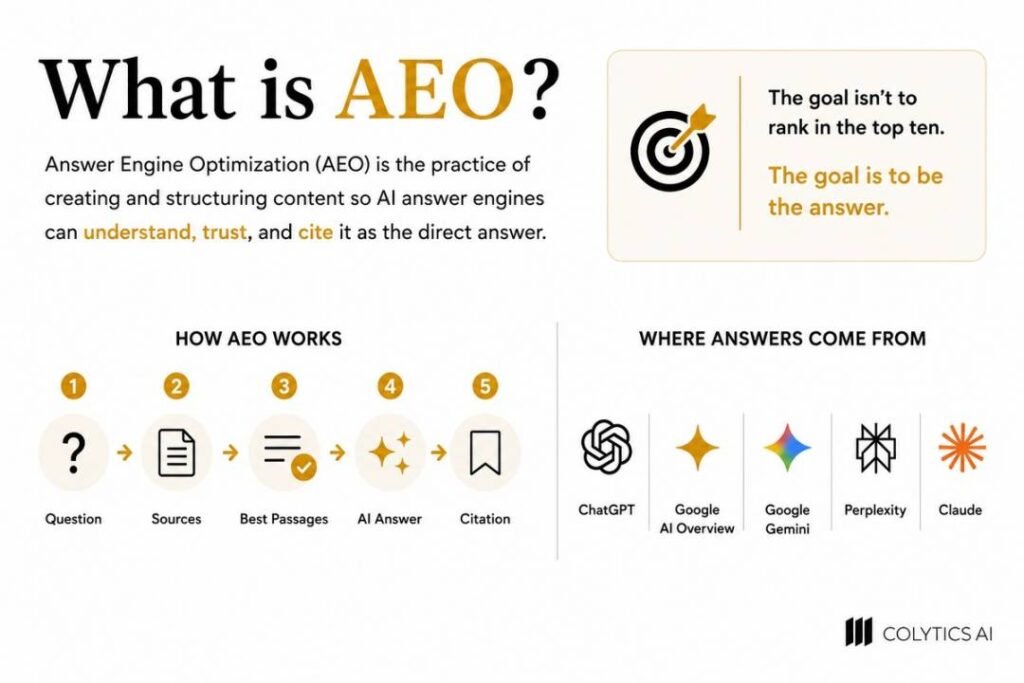
An answer engine gives users direct answers instead of a list of links. Examples include Google’s AI Overviews and AI Mode, ChatGPT, Perplexity, Google Gemini, Microsoft Copilot, and Claude. Voice assistants like Siri and Alexa also count as AI answer engines.
Traditional search rewards the page that ranks highest. Answer engines reward the passage that best answers the question. They pull information from many sources. AI engines pick the clearest and most credible pieces to form their response, usually with citations.
Your job is to make content AI can trust and cite. That’s different from improving rankings alone. Still, both approaches build on the same basics.
Four things decide whether AI cites your content:
- How extractable your content is
- How clearly you signal entities and topic authority
- How much trust your brand carries
- Whether you are able to measure that you are being cited
The rest of this guide on answer engine optimization unpacks each one.
This shift matters because people already use AI for answers. Around half of US adults now use AI chatbots, according to a 2026 Pew Research survey. The most common use of AI chatbots is searching for information.
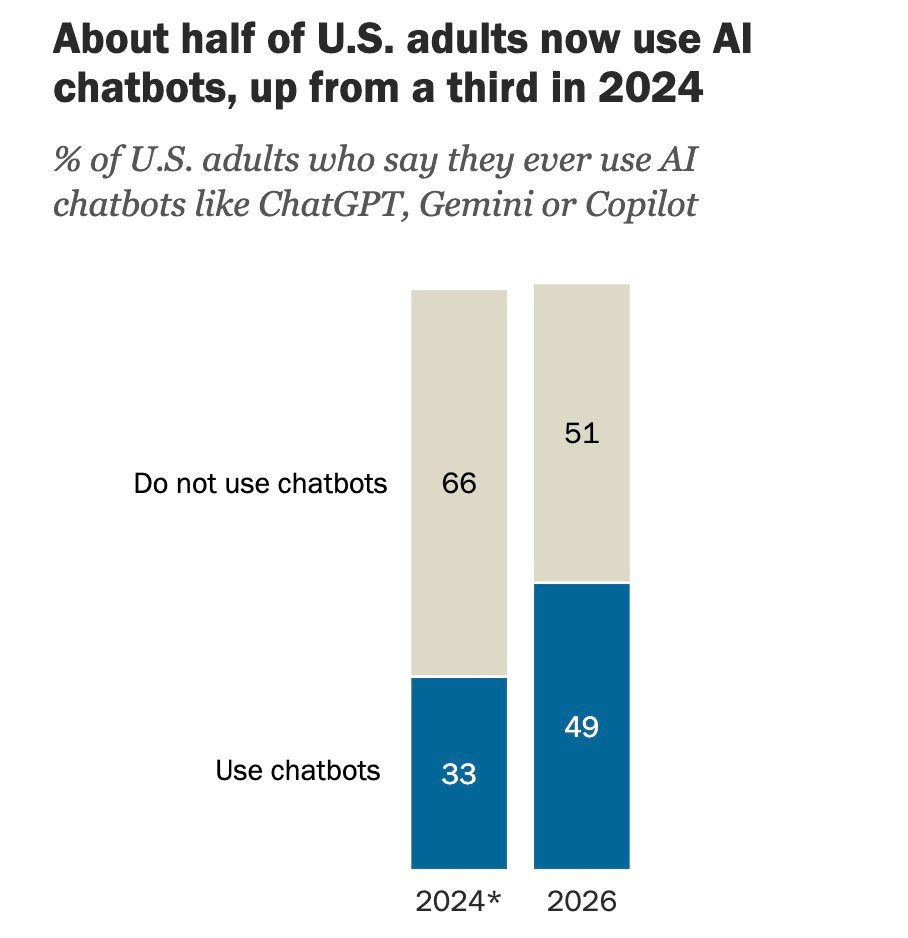
Image via Pew Research Center
Answer engine optimization isn’t a completely new discipline. It’s the next step in how people find brands online. If buyers use AI engines for search, instead of search engines, you want your brand in the answer.
It also helps to understand today’s landscape. ChatGPT is the most widely used answer engine today. Google’s Gemini, Microsoft Copilot, and others follow closely behind. Claude and Perplexity are popular among professionals.
Each answer engine generates answers a little differently. However, they all reward content they can read, trust, and cite.
Here’s a simple example to understand AEO.
Ask an engine for the best way to measure AI visibility. It will not return ten links. Instead, it’ll write a short answer and cite a few sources.
That’s what AEO is about: getting your brand cited in the AI answers. Anyone familiar with SEO will recognize the idea. You’re still building trust and clarity. The difference is that AI summarizes before linking.
What is AEO, in Short?
Answer engine optimization is the practice of structuring content so AI engines can extract and cite it as a direct answer. It is optimizing to be the answer, not just to rank a link.
Why Does Answer Engine Optimization Matter in 2026?
Answer engine optimization matters because many people now use AI to get answers. The typical process of using a search engine and clicking on results still exists. However, AI summaries are becoming an easier alternative. So, if you only invest in SEO, you’ll lose visibility in AI answers.
The data shows how search behavior is changing.
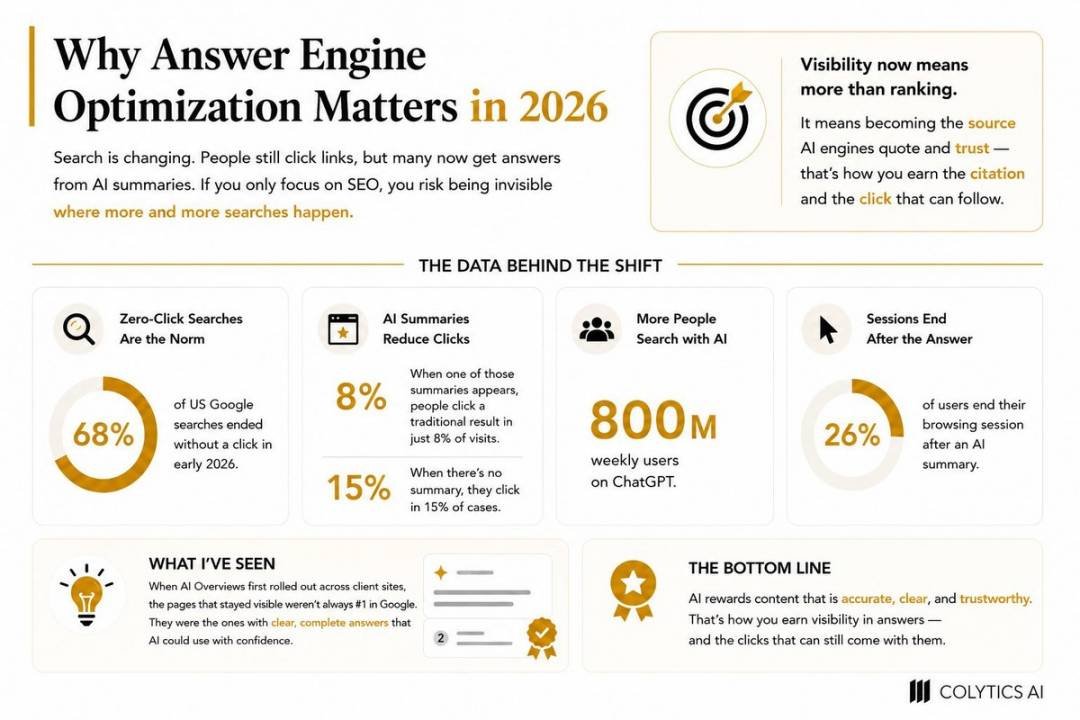
Here’s why AEO has become essential.
- More People Now Search with AI: ChatGPT surpassed 800 million weekly users, according to OpenAI 2025 data. Google’s AI Mode crossed one billion monthly users by mid-2026. Back in 2024, Gartner predicted that search volume would fall 25% by 2026 as people shifted to AI assistants. The forecast seems correct, as the data show a similar trend.
- Zero-Click Searches are Now the Norm: Data from SparkToro’s 2026 study supports that. In early 2026, about 68% of US Google searches ended without a click. People get their answer on the results page as AI overviews and move on. Here’s what an AI overview looks like on Google SERP.
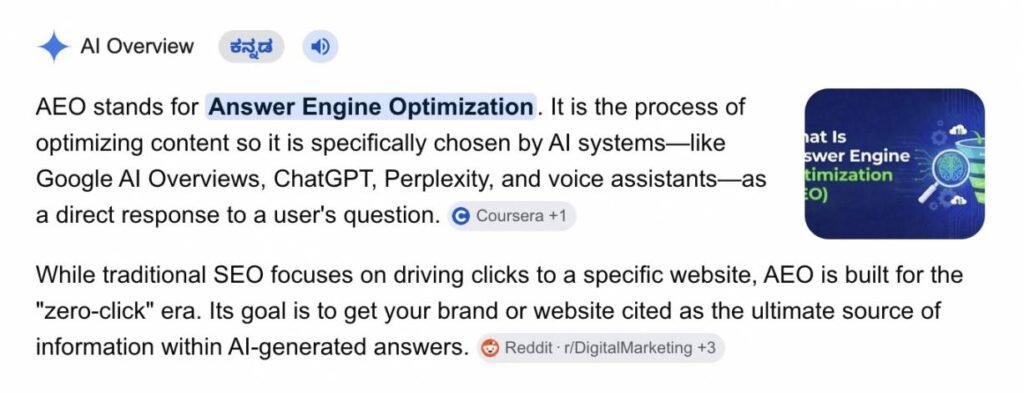
Image via Google
- AI Summaries Reduce Website Clicks: A 2025 Pew Research study of real browsing behavior showed interesting results. 18% of searches produced an AI summary in March 2025, and question-style queries triggered them far more often. When one of those summaries appears, people click a traditional result in just 8% of visits. When there’s no summary, they click in 15% of cases. An AI summary roughly halves the chance someone clicks through to a site.
So the definition of visibility is changing. It used to mean ranking on page one. Now it also means being the source an answer engine quotes.
I’ve watched this happen across many client websites when AI Overviews first rolled out. The pages that kept getting visibility weren’t always ranked first. They were the pages that gave AI a clear, complete answer it could confidently use.
The effect doesn’t stop with lower click rates. According to the 2025 Pew study, about 26% of users ended their browsing session after reading an AI summary. That number was only 16% when no summary appeared. Once people get the answer they need, many don’t look any further.
Search intent matters too. AI summaries appear much more often for detailed, question-based searches. The 2025 Pew study also found that ~53% of searches with ten or more words triggered an AI overview. About 60% of searches beginning with who, what, when, why, or how also produced a summary. Those are the exact questions your audience asks before making a decision.
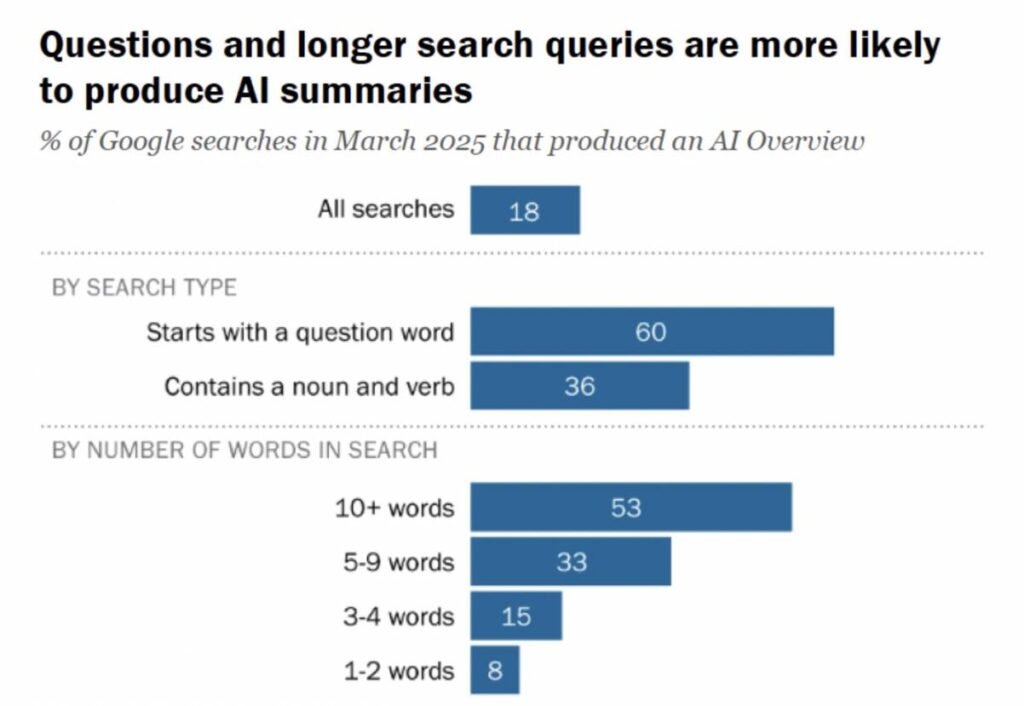
Image via Pew Research Center
Trust, though, is still catching up with usage, and that gap is the opening for credible brands. In a late-2025 Pew survey, about 65% of US adults said they at least sometimes see these AI summaries, yet only 6% said they trust them a lot.
If AI sees your content as accurate and trustworthy, it’s much more likely to cite it. That’s how you earn visibility in AI search. You may also earn the click when readers want to learn more.
Today, trust and authority are no longer optional. They’re the foundation of answer engine optimization (AEO).
Why Does AEO Matter?
Most searches now end without a click, and AI summaries roughly halve the click-through to websites. Visibility increasingly means being cited in the answer, so brands that structure content for extraction win attention that used to come only from rankings.
How Do Answer Engines Actually Work?
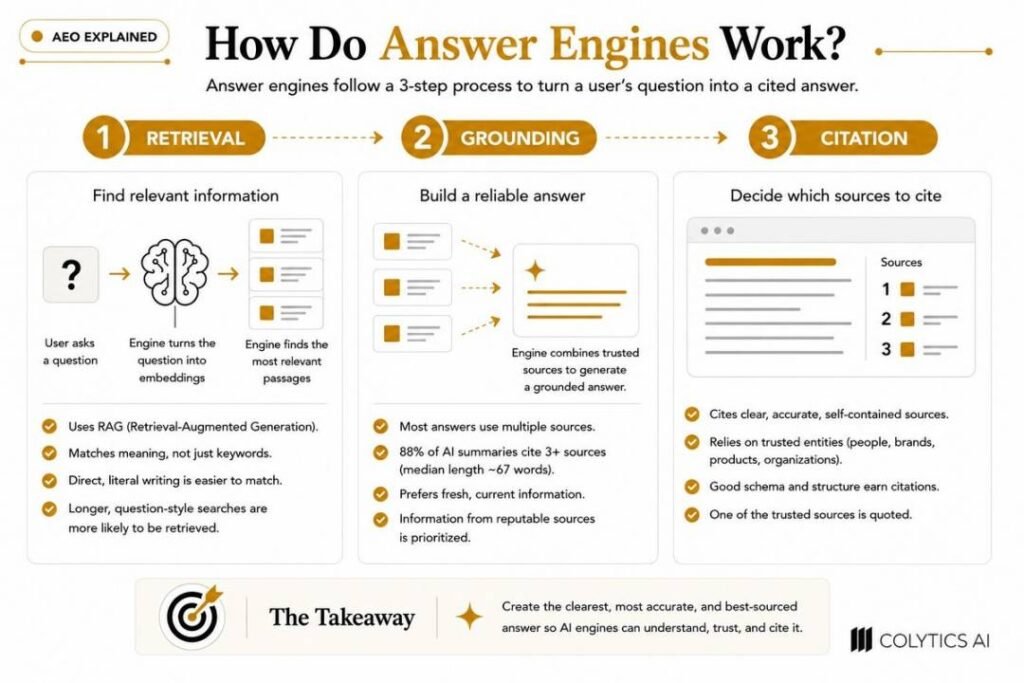
Answer engines don’t answer from memory. They follow a repeatable process every time someone asks a question. First, they find relevant information. Next, they generate an answer using that information. Finally, they decide which sources deserve a citation.
Here’s the process you need to understand to master answer engine optimization.
1. Retrieval: Find the Most Relevant Information
Most answer engines use a method called retrieval-augmented generation (RAG). Before generating an answer, they search a web index or live web for fresh, relevant information. They don’t rely only on their training data.
To do this, AI engines convert your content and the user’s question into mathematical representations. These are called embeddings. Rather than matching exact keywords, embeddings compare meaning.
That’s why clear, direct writing performs better than keyword stuffing. A page that answers the question in plain language is easy for answer engines to understand.
Search intent also plays a role, as I mentioned before. Longer, question-based searches often contain stronger signals about what users want. If your content answers those questions directly, AI will likely retrieve it to form the answers.
2. Grounding: Build a Reliable Answer
After retrieving relevant information, the model builds its response. This stage is called grounding.
Answer engines do not cite everything they read. They favor sources that are clear, self-contained, and widely trusted. That’s because they extract the answer from reliable sources rather than making things up.
Most answer engines don’t rely on a single page. They combine information from several trusted sources into one response.
A 2025 Pew Research study found that 88% of AI summaries cited three or more sources. They had a median summary length of about 67 words.
That’s encouraging because you’re rarely competing for one citation. Instead, you’re competing to be one of the many trusted sources for an answer.
The same study also found that summaries relied on widely cited sources. These include Wikipedia, YouTube, and Reddit, which account for roughly 15% of cited sources. Government sources accounted for 6% of citations.
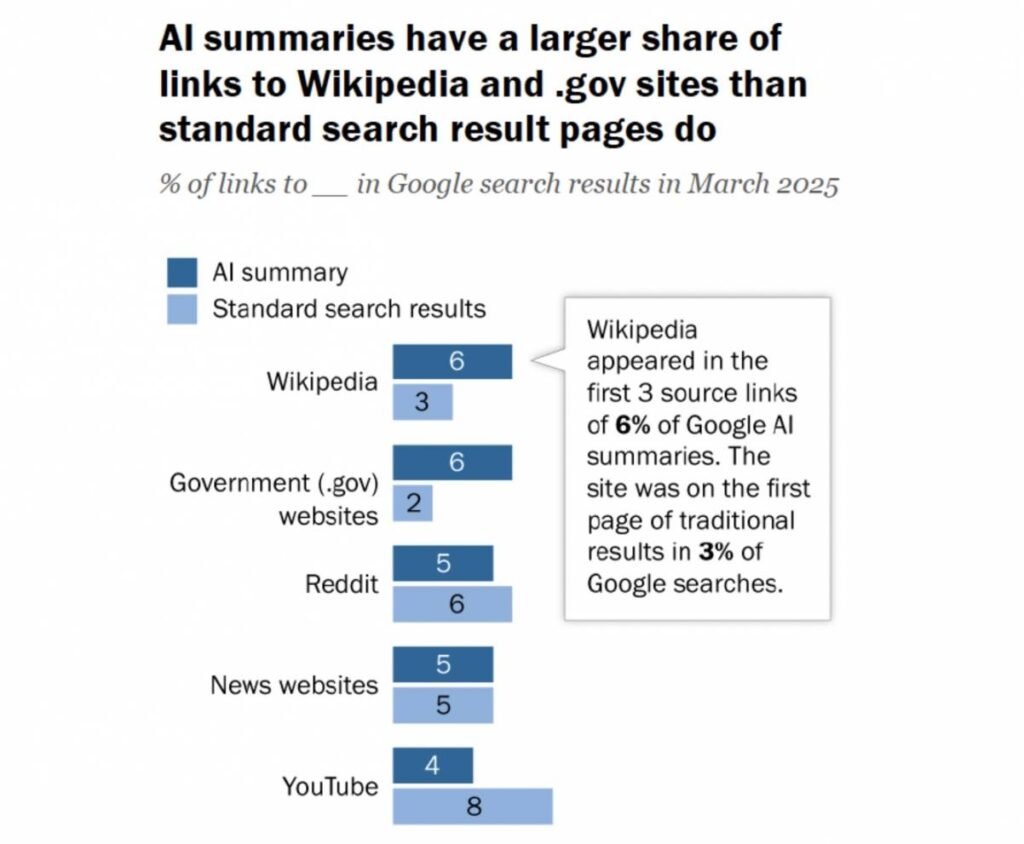
Image via Pew Research Center
Freshness also plays a role. Answer engines prefer information that is current and supported by other reliable sources.
So, if your content matches what other credible sites claim, it’s better for you. AI engines can confidently use it to form their answers.
3. Citation: Decide Which Sources to Cite
Not every page that AI engines use to form an answer earns a citation. Answer engines choose sources they believe users can trust.
They generally prefer content that is:
- Clear and easy to understand
- Answer the question clearly
- Accurate and backed by research
- Published by trusted sources
- Consistent with information found elsewhere
They also rely on entities: the people, brands, products, and concepts they recognize and connect in a knowledge graph. If an engine clearly understands who you are and what you are known for, you become a safer source to cite.
Good structure also helps increase your chances of getting a citation. Schema markup, headings, and logical formatting make content easier for AI to read.
However, structure alone won’t help you earn citations. If the information is weak, outdated, or inaccurate, clean formatting won’t make up for it.
That’s the practical goal of answer engine optimization. Create the clearest and most trustworthy version of the answer.
How Do Answer Engines Work?
Before an AI engine answers a question, it looks for useful information. Then it combines the best sources into one answer. Finally, it cites the pages it trusts most. Good content makes this process easy.
AEO vs SEO vs GEO: What’s the Difference?
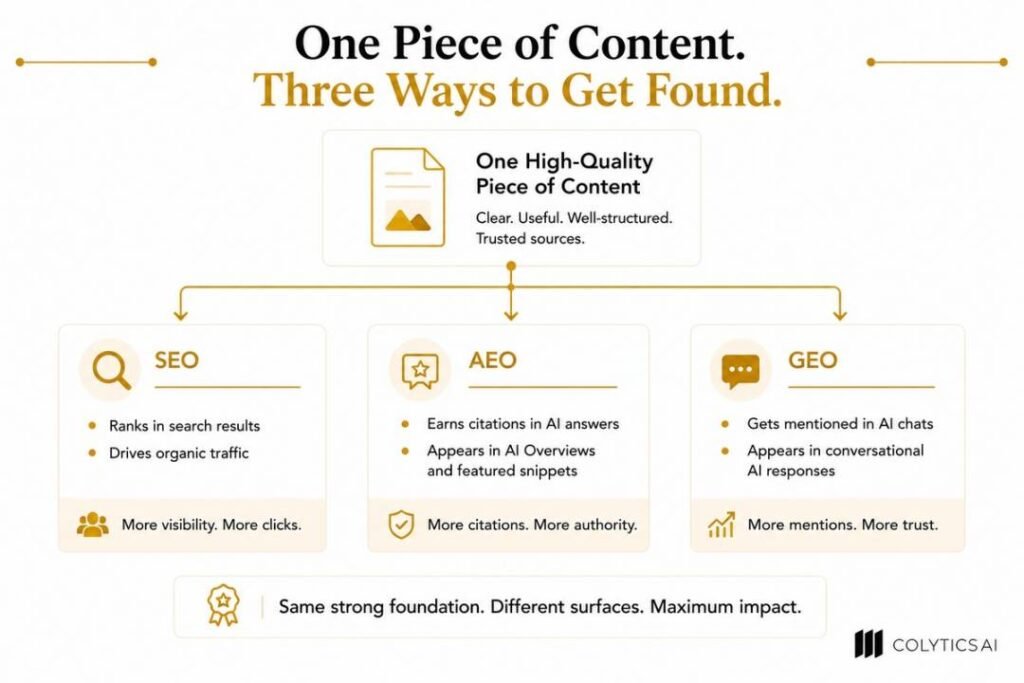
AEO, SEO, and GEO all help people find your brand. The difference is where they help you appear. SEO helps your content rank in search engine results pages. Answer engine optimization helps your content appear in AI summaries. GEO targets the responses generated inside tools like ChatGPT and Perplexity.
Generative engine optimization (GEO) focuses on earning mentions and citations inside AI-generated responses. Its goal is to help your content be a part of chat-style conversations people have with AI platforms.
This is different from AEO, which focuses on AI overviews and feature snippets.
You’ll also see AIO, or AI optimization, used as an umbrella term for both.
| Dimension | SEO | AEO | GEO |
|---|---|---|---|
| Goal | Rank a link | Be the cited answer | Get cited inside a generated response |
| Surface | Blue-link results | AI Overviews, featured snippets, voice | ChatGPT, Perplexity, Gemini, Copilot |
| Unit of success | Position and click | Extracted answer or citation | Brand mention in the answer |
| Primary signals | Backlinks, relevance, technical health | Structure, schema, clarity, entities, E-E-A-T | Authority, citations, brand mentions, freshness |
| Measured by | Rankings, organic traffic | AI-answer presence, citation share | Mention frequency, share of voice in AI |
It’s easy to think of SEO, AEO, and GEO as three different marketing strategies. In reality, they work best together. They all have the same goal: helping people find your content. The only difference is where people find it.
In my experience, the cleanest way to think about it is also the simplest. AEO and GEO are extensions of SEO, not replacements for it. You are adding a new way to be found on top of a foundation you already understand.
Good SEO still matters because it helps search engines understand your website. AEO builds on that by helping AI extract and cite your content. GEO takes it one step further by helping your brand appear naturally in longer AI conversations.
That’s why I wouldn’t create three separate content strategies.
I’d focus on creating one outstanding piece of content first. Then I’d improve its structure, add trusted references, and answer common questions. I’ll also make the page easy to scan.
Those changes help every search experience, not just one.
But how do you prioritize among the three?
Your first priority should always be the basics. If your website has technical SEO issues, confusing navigation, or thin content, fix those first. Strong SEO lays the foundation for AEO and GEO.
Specifically, regarding AEO vs GEO, the difference lies in where the answer appears. AEO helps your content appear in direct-answer formats like Google AI Overviews. GEO helps your brand appear naturally in longer conversations with AI assistants.
The content that succeeds, however, looks remarkably similar. It’s clear, accurate, well-organized, and supported by trustworthy sources.
I’ve seen this happen with client content more than once. A single piece of content can rank across all platforms if it:
- Explains a topic clearly
- Answers the most common questions
- Backs up its claims with credible sources
Nothing about the content changes. What changes is where people discover it.
That’s the real value of combining SEO, AEO, and GEO. Instead of building three separate content strategies, you create one resource that can earn visibility everywhere.
Is AEO different from SEO and GEO?
Yes, but they work together rather than compete. SEO helps your pages rank in traditional search results. AEO helps your content become the answer AI engines quote. GEO helps your brand get mentioned in AI tools like ChatGPT and Perplexity
What are the Core Elements of AEO?
Answer engines reward content they can extract, a site they can read, and entities they recognize. They also prefer brands they can trust. Get these right, and you become the easy, safe source to cite.
Let me explain these core elements of answer engine optimization in more detail.
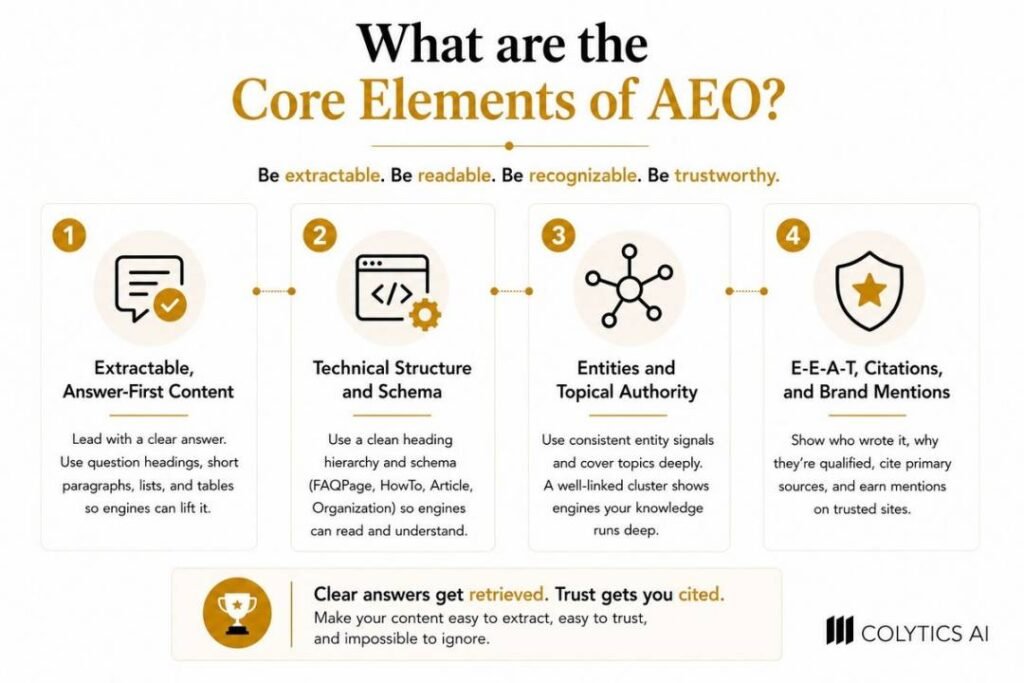
1. Extractable, Answer-First Content
Start by answering the main question in 40 to 60 words. Don’t save the answer for the end of a section. Give your readers a clear response first, then expand with more detail.
How you structure your content also matters.
Use question-style headings, short paragraphs, clear lists, and tables. Each section should make sense on its own, because an engine may lift it without context.
2. Technical Structure and Schema
Make your pages machine-readable. Use a clean heading hierarchy: one H1 followed by ordered H2s and H3s. This ensures that an answer engine can map your structure without guessing.
Add structured data with schema markup. FAQPage, HowTo, Article, and Organization schema all help engines understand a page and its owner.
3. Entities and Topical Authority
Answer engines want to know exactly who they are citing. They recognize entities, such as companies, products, people, and well-known concepts. The easier it is for AI to identify who you are, the more likely it is to trust and cite your content.
Keep those signals consistent everywhere. Use the same brand name, products, and key people everywhere. Ensure your About page, social profiles, and any knowledge-base entries match.
You also need to show that your expertise goes beyond one page. Cover your main topics in detail instead of writing one standalone article. Cover your main topics in detail instead of writing one standalone article.
A collection of well-linked pages tells answer engines that your knowledge runs deep. It also makes your site a stronger candidate for citations.
4. E-E-A-T, Citations, and Brand Mentions
Clear answers help your content get retrieved, but trust helps you get cited.
Answer engines pay close attention to the quality signals behind your content. Google groups these signals under E-E-A-T: experience, expertise, authoritativeness, and trust. The more evidence you provide, the easier it is for an answer engine to rely on your content.
That means showing who wrote the article and explaining why they’re qualified. You should also cite primary research and publish information that adds something new. It also helps when trusted websites mention your brand, even if they don’t link back to you.
A quick example ties these together. Picture two pages on the same topic. One opens with a clear answer, uses the FAQPage schema, names its author, and cites primary data. The other buries a vague answer halfway down, with no markup and no byline.
The first is easy to extract, verify, and trust, so it is the one an engine quotes. The other is difficult to trust, so it doesn’t get a citation. Same topic, very different outcomes, and it’s all because of trust.
| Element | What it means | How to act on it |
|---|---|---|
| Extractable Structure | Content an engine can lift as a standalone answer | Lead with a 40–60-word answer; use question headings, lists, and tables |
| Schema Markup | Structured data that labels your content | Add FAQPage, HowTo, Article, Organization; match the visible page |
| Entities and Topical Authority | How clearly an engine recognizes your brand on a topic | Keep names consistent; cover topics in depth; align your profiles |
| E-E-A-T | Experience, expertise, authoritativeness, trust | Named expert authors, primary sources, and original data |
| Freshness | How current the content is | Show update dates; refresh facts and stats on a schedule |
| Off-Site Citations and Mentions | How often trusted sites reference your brand | Earn digital PR and mentions, not just links |
| AI Crawlability | Whether AI bots can fetch your pages | Allow GPTBot, ClaudeBot, PerplexityBot, and Google-Extended in robots.txt |
I’ve found that structure often matters more than people expect. I optimized several pillar pages for a client to ensure every section began with a clear answer. I also improved the site’s entity signals.
The results came faster than expected. Those pages started showing up in AI answers for topics where they had never ranked before.
It didn’t require any effort in new content creation. I delivered the results through answer engine optimization.
What Do Answer Engines Reward Most?
Answer engines favor content that is clear, well organized, and easy to trust. They cite pages with recognizable entities and clear E-E-A-T signals. So, structure and credibility matter more than keyword volume.
How to Optimize Content for Answer Engines
The first step of answer engine optimization is to structure your content for extraction. Use schema markup, build entity and topical authority, and strengthen your E-E-A-T signals. Also, make sure AI crawlers can reach your pages. Here is how I work through each step.
1. Structure Content for Extraction
Start every page and every major section with the answer. Give readers the 40-to-60-word version first. Then expand on it for anyone who wants more detail.
Next, organize the rest of the content so it’s easy to scan. Use question-based headings, short paragraphs, bullet lists, and tables. Each section should stand on its own because answer engines may extract only that part of the page.
Here’s a simple example. Consider this statement:
- “There are many factors that influence how AI tools surface content, and we’ll cover them below.“
That doesn’t give an engine anything useful to quote, as there are no specifics.
Now compare it with this:
- “Answer engines reward four things: extractable content, clean structure, recognized entities, and trust.”
This sentence answers the question immediately. It’s clear, self-contained, and easy to quote.
Whenever possible, write like the second example. It gives both readers and AI a clear takeaway without making them search for it. That’s exactly the kind of content answer engines prefer.
2. Implement the Right Schema
Think of schema as labels that explain your content to search engines and AI.
Choose the label that fits the page. Use Article for articles, FAQPage for FAQs, and HowTo for tutorials. You can also use Organization for information about your business.
Here is a minimal FAQPage example:
{

  “@context”: “https://schema.org”,

  “@type”: “FAQPage”,

  “mainEntity”: [{

    “@type”: “Question”,

    “name”: “What is answer engine optimization (AEO)?”,

    “acceptedAnswer”: {

      “@type”: “Answer”,

      “text”: “Answer engine optimization (AEO) is the practice of structuring content so AI answer engines can extract, trust, and cite it as a direct answer.”

    }

  }]

}
Only mark up content that actually appears on the page. Schema that does not match the visible page can do more harm than good.
Use Google Rich Results Test to check if you have properly added schema markup to any page. Here’s an example of a test result.
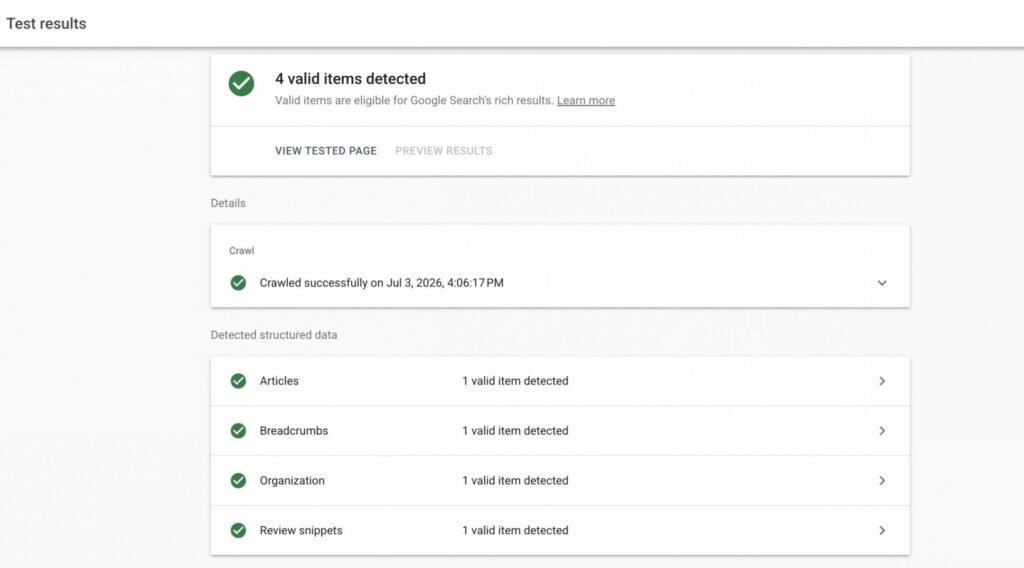
Image via Google Rich Results Test
Pick the right schema for the page you’re creating. Use Article for articles, FAQPage for FAQ, and HowTo for instructions. Also, use Organization and Person for your brand and authors.
Always test your schema before publishing. A broken property can prevent it from working. A good schema helps answer engines understand your page, but it can’t make weak content stronger.
3. Build Entity and Topical Authority
Build your authority one topic at a time. Choose a subject that’s important to your audience and cover it from different angles.
Publish related articles, answer common questions, and connect those pages with internal links. Over time, that creates a strong topical cluster.
Keep your brand identity consistent as well. Your brand name, author bio, and business descriptions should match across platforms. That helps AI engines connect everything to the same entity.
You should also connect your content wherever it makes sense. Link to related articles, reference earlier content, and cite your original studies. The stronger those connections are, the easier it is for AI to understand what your brand is known for.
4. Strengthen E-E-A-T and Citations
Trust is an integral part of answer engine optimization.
Answer engines want to know who created the content and why they should trust it.
Show that your article comes from someone with real experience. Add the author’s name, credentials, and bio.
Here’s an example of a clear and concise author bio you can take inspiration from.
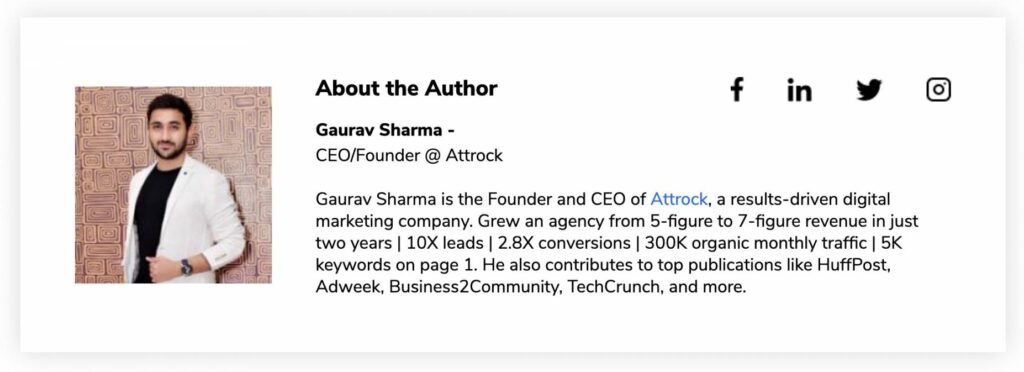
Image via Attrock
Cite primary sources by name and add original data wherever you can. First-hand data is the strongest citation magnet there is.
I’ll be honest about the order here. If you do not have first-party data yet, lead with genuine first-hand experience and well-named sources. Then, publish original studies and cite data from those.
Here are the signals I focus on most:
- Author name and bio
- Clear publish and last-updated dates
- Links to credible, primary sources
- Original insights, examples, or data
These signals make your content easier to verify. They also give answer engines more confidence when choosing what to cite.
5. Make Your Site Crawlable to AI
None of this works if the engines cannot reach your pages. Start by checking your robots.txt file. Make sure it allows the AI crawlers you want to reach your content.
The common AI crawlers include GPTBot, OAI-SearchBot, ClaudeBot, PerplexityBot, and Google-Extended. Crawler names and policies can change. So, always check the latest documentation before updating your settings.
Lastly, review your technical setup. Make sure your most important pages aren’t blocked. Also, keep your XML sitemap updated so crawlers can find new content quickly.
How Do You Optimize Content for AEO?
Write clear answers first, then add more detail below them. Use question-based headings and schema markup to help AI understand your content. Show who wrote the article, support your claims with trusted sources, keep your brand information consistent, allow AI crawlers to access your pages, and track your AI citations.
Your Copy-Paste AEO Checklist
- Answer the question in the first 40 to 60 words of the page and each section
- Use question-style headings in a clean H1 → H2 → H3 hierarchy
- Add FAQPage, HowTo, Article, or Organization schema that matches the page
- Keep paragraphs short and sections self-contained
- Name a real author with visible credentials
- Cite primary sources and add original data where you can
- Keep your brand name, bios, and descriptions consistent everywhere
- Build topical depth across a cluster of linked pages
- Show clear publish and last-updated dates
- Earn off-site brand mentions, not just backlinks
- Allow GPTBot, ClaudeBot, PerplexityBot, and Google-Extended in robots.txt
- Track which queries cite you, then double down on what works
How to Measure AEO Success
Answer engine optimization (AEO) changes the way you measure success. You don’t look only at search rankings. Instead, you also need to know how often AI engines mention your brand.
The most useful metrics are AI citations, share of voice, AI referral traffic, and more.
Each metric fills in part of the picture.
Citations show how often AI chooses your content. Share of voice tells you whether you’re gaining ground on competitors. Referral traffic measures clicks from AI platforms.
So, you should track several of these to see the results of your answer engine optimization efforts.
Here’s a table you can reference to understand the key AEO metrics at a glance.
| KPI | What it tells you | How to track it |
|---|---|---|
| AI Citation or Mention Frequency | How often AI answers cite or name you | Sample target prompts across engines on a schedule |
| Share of Voice in AI Answers | Your visibility versus competitors | Compare your citations to rivals’ for the same prompts |
| AI Referral Traffic | Visits arriving from AI tools | Segment referrers (chatgpt.com, perplexity.ai, and so on) in analytics |
| Branded-Query Lift | Rising demand for your brand | Watch branded search volume over time |
| AI Overview Presence | Whether you appear for key queries | Check target queries and log when you show up |
Measuring this is harder than checking a ranking. Answers vary by user, phrasing, and engine, so there is no single position to look up. You have to sample priority questions across engines repeatedly and track how often you appear.
This is one of the main reasons I built Colytics AI. I wanted a simple way to see where AI engines were mentioning a brand and where they weren’t.
Colytics AI tracks citations across ChatGPT, Google AI Overviews, Perplexity, and other AI platforms. It also shows your share of voice, so you can see how your visibility changes over time.
Here’s a screenshot showing the detailed report it generates.
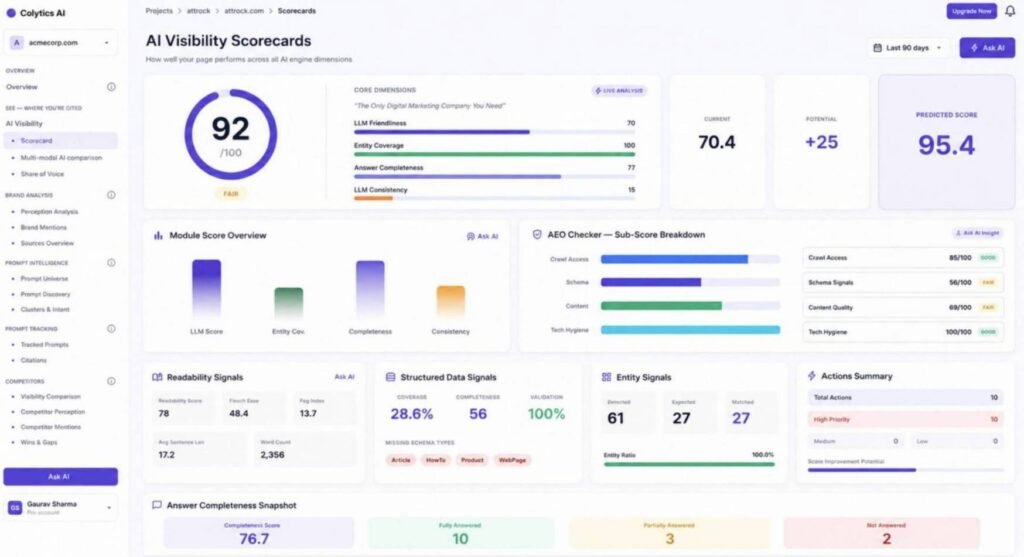
Image via Colytics AI
The process itself is straightforward. Decide which questions matter most to your business. Check who gets cited for those questions, then improve the content where you’re missing.
It’s worth remembering that no tracking tool sees every AI response. The numbers aren’t perfect, but they’re consistent enough to show meaningful trends. That’s what matters most.
In my experience, early progress usually appears within a few weeks. Answers for a handful of key questions start mentioning the brand where they didn’t before. Those early wins make it much easier to decide what to optimize next.
Getting started is actually quite easy. Start with a list of 10 to 20 customer questions and check for your brand mentions across the main AI engines weekly. After a month, you’ll have a useful benchmark.
Automation simply makes that process faster. Tools like Colytics AI can monitor far more prompts than anyone could check manually. They also highlight changes in your share of voice, making it much easier to measure progress.
Finally, compare your AI data with the metrics you already track. As AI citations increase, you may also notice more branded searches and direct traffic. Many people first discover a brand through an AI answer, then search for it later when they’re ready to learn more.
How Can You Measure AEO Success?
The best way to measure AEO is to track your AI citations over time. Also monitor your share of voice, AI referral traffic, and branded search growth. Frequency also matters, so you should also track how often you appear in AI answers. Run the same set of questions across different AI engines every week or month. The goal is to spot patterns and measure progress over time.
What are the Common AEO Mistakes to Avoid?
The most common mistakes here share one root: making an engine work too hard to find and trust your answer. Fix that, and most of these disappear.
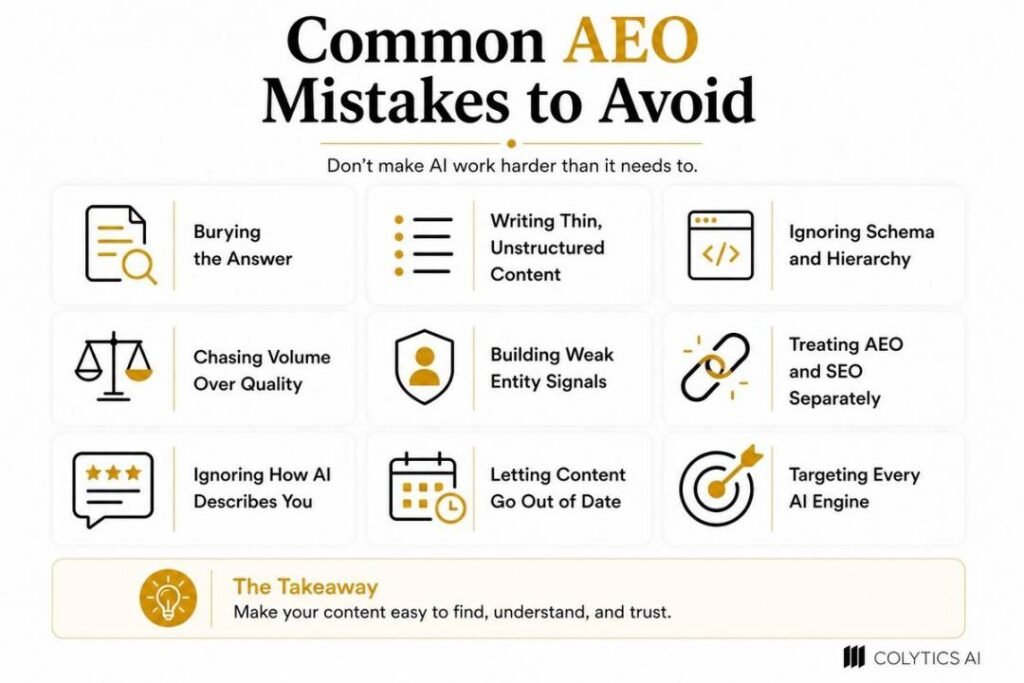
- Burying the Answer: Put the answer at the beginning of the page or section. Don’t make readers or AI search for it. This is a key part of answer engine optimization.
- Writing Thin, Unstructured Content: Give every section enough detail to answer the question well. Use headings, lists, and tables to organize the information.
- Ignoring Schema and Hierarchy: Add structured data and clear H1, H2 tags. This helps the answer engines better understand your content.
- Chasing Volume Over Quality: Publishing more pages won’t help if they don’t answer questions clearly. Focus on quality first.
- Building Weak Entity Signals: Use the same brand name, author bios, and business details across channels. This helps build a consistent brand identity.
- Treating AEO and SEO Separately: Don’t think of AEO as a replacement for SEO. Strong SEO gives you the foundation for better AI visibility, so build on what you already have.
- Ignoring How AI Describes You: Check how AI engines describe your brand. If the information is wrong or incomplete, you need to know so you can fix it.
- Letting Content Go Out of Date: Update your key pages regularly. Fresh facts, current statistics, and recent examples help answer engines trust your content.
- Targeting Every AI Engine: You don’t have to optimize for every platform on day one. Start where your audience spends time, then grow from there.
Avoid these mistakes, and you’ll see great results from answer engine optimization.
What are the Biggest AEO Mistakes?
The biggest AEO mistakes are making content difficult to extract or trust. This includes burying the answer, using weak structure, skipping schema, or publishing thin or outdated content. Starting from scratch, instead of building on the foundation of SEO, is also a common mistake.
What’s the Future of Answer Engine Optimization?
The future of answer engine optimization is bright. People will get more answers directly from AI and click fewer links. Many people will use AEO, SEO, and GEO together, rather than replacing one for the other. The platforms may change, but the goal stays the same: create content that gives the best answer.
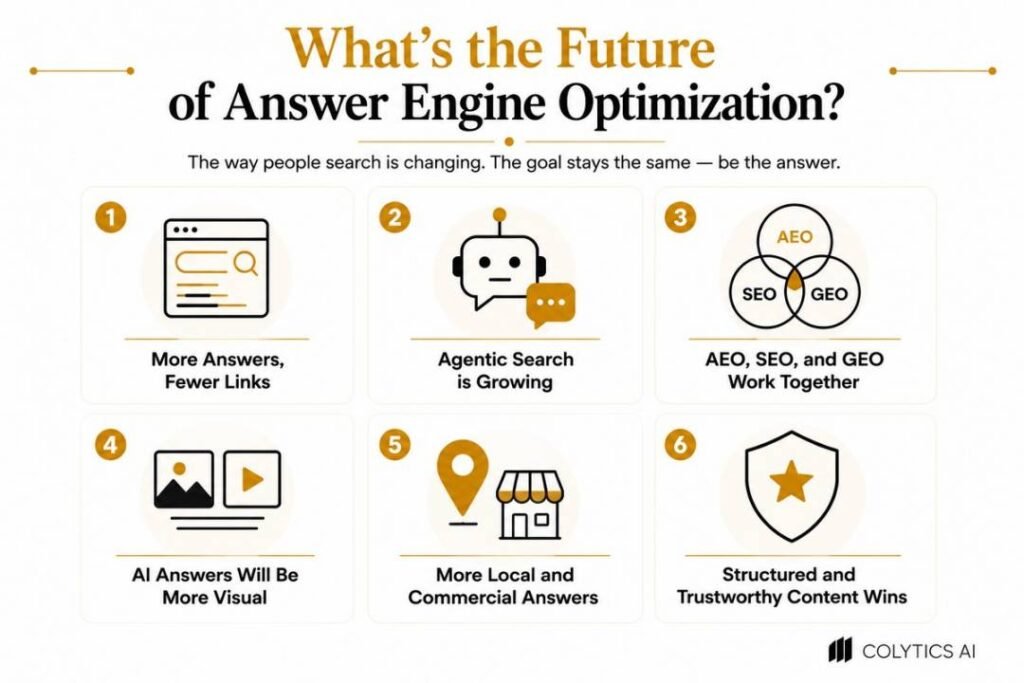
A few shifts are already taking shape. Agentic search is growing, where assistants do not just answer but take actions on a user’s behalf. This raises the bar for being the recommended option.
AI answers are also becoming more visual. Text now appears alongside images and videos, so strong visual content matters more than ever.
The way we measure success is changing too. Tracking how often your brand appears in AI answers will soon become as common as tracking search rankings. As this happens, the lines between AEO, GEO, and SEO will likely continue to fade.
In my view, the brands that win will not be the ones chasing every new acronym. They will be the ones with genuinely useful, well-structured, and trustworthy content. That’s exactly what today’s AI engines and search engines are built to reward.
Now is a good time to prepare. Build your best content to answer questions first and attract traffic second.
Start monitoring your AI citations now. The teams that learn from this data today will have a better understanding of their audience tomorrow.
I also expect local and commercial answers to grow quickly. As people ask engines what to buy and who to hire, the brands with clear, trustworthy, well-structured information will be the ones those answers name.
Where is Answer Engine Optimization (AEO) Heading?
Answer engine optimization is quickly becoming more important than ever before. More people will get answers from AI, rather than clicking on links. People will treat AEO, GEO, and SEO as one unified strategy. The focus will be more on credible, well-structured, and extractable content.
FAQ
Q1. What is answer engine optimization (AEO)?
A. Answer engine optimization is about helping AI find and use your content. It makes your content easy to understand, trustworthy, and ready to cite. Instead of only trying to rank in search results, the goal is to become the answer AI gives users.
Q2. What does AEO stand for?
A. AEO means answer engine optimization. It involves optimizing content for AI tools that answer questions, such as ChatGPT. Using the full term also makes it clear you are talking about search, not the AEO retail brand.
Q3. How does answer engine optimization work?
A. AI answer engines look for the best content to answer a question. They prefer information that is clear and trustworthy. It should also be easy to scan and understand. AEO makes your content easy to find, understand, and cite.
Q4. What is the difference between AEO and SEO?
A. SEO focuses on improving your visibility in search results. AEO focuses on helping AI engines understand and cite your content. They use the same foundation of helpful, accurate, and well-organized content. So, SEO and AEO work together.
Q5. What is the difference between AEO and GEO?
A. AEO helps your content appear in AI Overviews, featured snippets, and voice results. GEO focuses on longer responses created by AI tools like ChatGPT and Perplexity. Both aim for citations and overlap heavily, and AIO is sometimes used as an umbrella term for both.
Q6. What is AEO in marketing?
A. AEO means optimizing your content so AI tools recommend and cite your brand. It helps your brand become part of AI-generated answers. This can build awareness and demand even when no one clicks through.
Q7. How do I optimize my content for answer engines?
A. Give a clear 40-60-word answer at the top of the page before adding more details. Organize your content with question-based headings and short sections. Add schema markup, show who wrote the content, and cite trusted sources. Make sure AI engines can crawl your website.
Q8. Does schema markup help with AEO?
A. Yes, schema markup gives AI engines more context about your content. That makes it easier for them to understand and organize your pages. While it supports AEO, it cannot replace high-quality content. Clear, trustworthy information is still the biggest ranking factor.
Q9. How do I measure whether AI is citing my content?
A. Search for your target keywords in different AI answer engines and see if your brand is named or cited. Compare your results with competitors and review AI referral traffic in your analytics. Since AI responses change often, measure long-term trends instead of one-time results.
Q10. Is AEO replacing SEO?
A. No, AEO is building on SEO, rather than replacing it. Answer engines reward the same high-quality content that ranks in search. The smartest approach is to keep strong SEO fundamentals and build on that for AEO.
Ready to Use AEO to Boost Your AI Visibility?
Answer engine optimization is more than another marketing term. It is a practical way to prepare your content for how people search today. Creating content that provides direct answers and is good enough to be cited is the way forward.
You do not have to rebuild your content strategy from scratch. Keep creating useful content, answer questions clearly, and make it easy for AI to understand. Small improvements made consistently often deliver better results than big one-time changes.
Want to see how often AI mentions your brand? I’ve built Colytics AI to help with exactly that. Check out the product and sign up for early access.